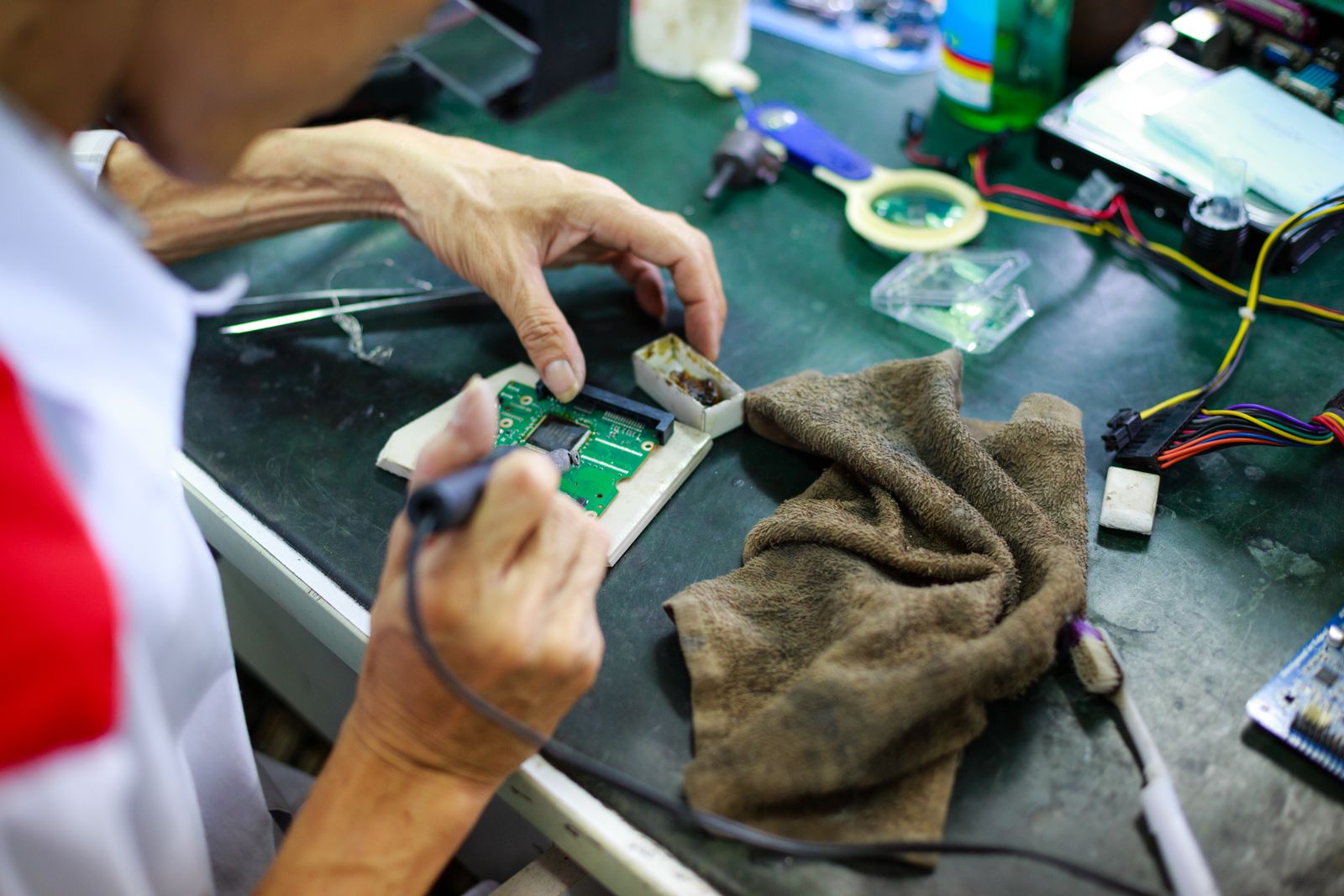
Keep the work behind the assembly.
Assembly combines object handling, tool use and checks. A technician identifies components, prepares the work surface, aligns parts, connects or fastens them and inspects the result. Useful data connects those actions to the initial arrangement and intended end state.
A procedure can include reorientation, a connector that does not seat, a tool change or a repeated check. Keep those corrections visible and distinguish what the camera shows from findings confirmed by a qualified reviewer.
Different trades. Shared industry.
Explore a first selection of roles and task examples. The directory also connects trades that work across industries.
Assembly & wiring
Electronics assembly technician
Assemble small modules, connect cables and document fastening, placement and inspection steps at a workstation.
Example tasks
- Fit an electronic module into an enclosure.
- Orient and insert a connector into its matching socket.
- Fasten an assembly and inspect the final arrangement.
Assembly & wiring
Wire harness assembler
Arrange, route and secure prepared cables and connectors against a defined assembly reference.
Example tasks
- Arrange prepared wires on a harness board.
- Insert prepared terminals into identified connector housings.
- Bundle cables and inspect routing and retention.
Inspection & quality
Electronics test technician
Set up an agreed test, connect the unit and retain the visible readings alongside the test conditions.
Example tasks
- Position an unpowered unit in an agreed test fixture.
- Connect the specified test leads and identify their reference points.
- Record permitted test readings and the reviewer’s conclusion.
Maintenance & repair
Electronics repair technician
Document access, module replacement and reassembly on agreed equipment, keeping observed and confirmed findings separate.
Example tasks
- Open an agreed enclosure and organize its fasteners.
- Remove and replace a removable module.
- Refit the enclosure and record the specified functional check.
Mechanical assembly & finishing
Precision assembly operator
Position small mechanical parts, manage fixtures and document the sequence and visible fit of an assembly.
Example tasks
- Place a small part in an assembly fixture.
- Align mating parts before fastening.
- Use an agreed gauge and record its visible reading.
Inspection & quality
Electronics quality inspector
Inspect assemblies against an agreed checklist and document visible conformity, defects and uncertainty.
Example tasks
- Compare component placement with an agreed reference.
- Inspect connector seating and cable retention.
- Record a visible defect and route the unit for review.
Workbench tasks, step by step.
Start with one bounded procedure. These candidate tasks help define a collection brief; they are not an inventory of datasets already available.
| Work area | Tasks to capture | What the record should show |
|---|---|---|
| Component preparation | Select parts, check identifiers and prepare the fixture. | Part identity, starting arrangement and placement. |
| Assembly & fastening | Align a module, position fixings and fasten the assembly. | Hand roles, tool changes, orientation and visible fit. |
| Cable & connector work | Route prepared cables, insert connectors and check seating. | Cable path, connector identity, alignment and corrections. |
| Inspection & testing | Inspect an assembly or document an agreed instrument test. | Checklist, inspected regions, visible readings and reviewer status. |
| Repair & rework | Remove an accessible module, replace or reseat it and recheck. | Initial condition, intervention sequence and observed result. |
Keep the conditions around the gesture.
Coverage should vary the parts, tools, initial states and working conditions that matter for the model. Retain visibility and uncertainty notes with each episode.
| What varies | Examples to include | Context to keep |
|---|---|---|
| Parts & layout | Connector types, part orientation and cable routing. | Part IDs, reference arrangement and starting state. |
| Visibility | Small components, reflective surfaces and occluded hands. | Camera views, visible intervals and review flags. |
| Technique & recovery | A misaligned part, tool change or repeated inspection. | Task stage, observed interruption and corrective action. |